On Governance Futures: What We Have Already Touched
Ouassima Laabich shares the conviction that governance futures cannot only be designed: they must first be dreamed, felt, and known somewhere in the body!
By Ouassima Laabich, Bilbao 2026
This text was delivered as a lightning talk at the Governance Futures Network Convening in Bilbao, which took place from June 2–5, 2026. The convening brought together practitioners, researchers, and activists from across the world working at the intersection of democratic innovation, transformative governance, and collective futures-making. I participate in the network as founder of Muslim Futures and dedicated Dream-Weaver: a space where I hold together critical futures thinking, decolonial perspectives, and radical imagination. What I shared in Bilbao emerges from this work: the conviction that governance futures cannot only be designed: they must first be dreamed, felt, and known somewhere in the body. The text remains as it was spoken: sudden, luminous, and gone again, leaving only an afterimage of what might be possible.
They call this a lightning talk.
I want to linger with that word for a moment. Lightning: sudden, luminous, disorienting. It illuminates something that was always there, quietly waiting for the right conditions to become visible. And then it disappears again, leaving you in the dark with an afterimage, a contour you now know exists.
I think this is what governance futures work can feel like, at its most alive.
Lately, I have been thinking a great deal about root systems. About what it truly takes to grow them, and who gets to participate in that growing. And I keep returning to a sentence that has stayed with me, simple and almost self-evident, and yet it landed like a stone dropped into still water:
People cannot take you where they have never been. You cannot reach the more just, the alternative, the desirable worlds through them
If we want to build governance futures in service of life, then the people shaping them must have already encountered those futures somewhere in their bodies. They must have dreamed them, mourned the distance from them, sensed their texture against their skin. A root system grows from what has already been lived and felt, not only from what has been planned or designed.
But then – what if we become vessels for one another?
Show me what you see. What you sense. What you long for. Let me become part of it, if I may. And I will do the same for you. This is perhaps how root systems actually grow: not from a single visionary center outward, but through countless entangled threads reaching toward one another in the dark, exchanging traces of what they have already touched.
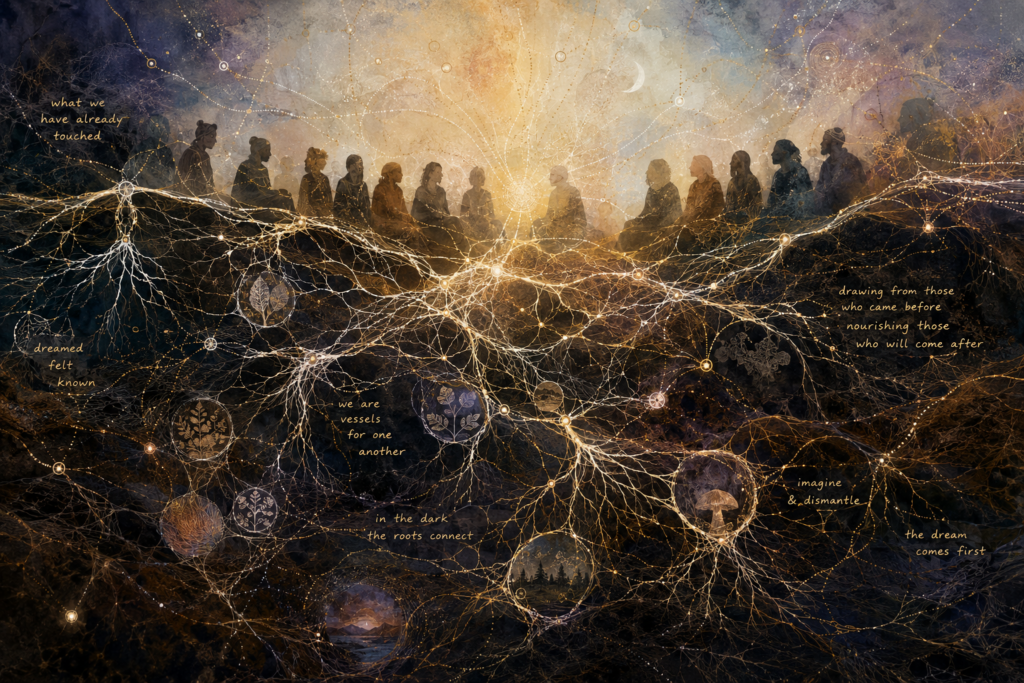
Freud once compared dream-thoughts to mycelium: they branch out in every direction into an intricate network, he wrote, and it is where this meshwork is particularly dense that the dream-wish grows — like a mushroom out of its mycelium. The network has no definite endings. It reaches down into what he called the navel of the dream, the spot where it touches the unknown.
I love this image. Because it means that when we dream, we are not generating something from nothing. We are drawing from a vast, generational web of connection — to our ancestors, to each other, to the land, to everything we have ever felt or been told or inherited. Forest scientists have shown that older trees actively nurture their kin through fungal networks, passing on nutrients and knowledge. When mother trees die, they release their stored wisdom into the network for those who come after.
This is what governance in service of life asks us to remember: that we are not building from scratch. We are drawing from a network that already exists, that runs beneath everything, that connects us to those who came before and those who will come after. And here is the part I want to stay with: this network does its work underground. In the dark. The roots of every living system grow downward, into the unseen, into places untouched by illumination. The mycelial threads holding a forest together live exactly where no one is looking.
We tend to speak of light as the destination, and darkness as what must be overcome. I want to resist that framing. We are the light, yes. But we are also the dark, and we need both — the courage to enter the unlit places, the uncertain futures, the unanswered questions, without flattening their complexity into easy binaries of progress and regress, hope and despair. The root system we are being asked to build together is one that knows how to remain alive in the dark.
And it is tended, always, by hands that have already felt their way through it. In my practice, what I have witnessed in the spaces I co-create – the tears, the laughter, the first moment someone sees themselves reflected without suspicion or deficit – has taught me what this tending requires. It requires that the people in the room have already, somewhere, however briefly, felt what it means to be held. To be safe. To be seen. Because we cannot design for a world we have never, even for a moment, inhabited.
Mariame Kaba writes that we do this work because we believe our dreams can become real. The dream comes first. The roots grow toward it. And Ruha Benjamin names the double movement: to imagine and craft the worlds we cannot live without, while dismantling the ones we cannot live within. Dreaming and dismantling, simultaneously. As governance. As a technology. As care.
So my offering for this gathering is simply this: bring what you have already felt. Bring the futures you have already tasted, however fleetingly, even if only in dreams. Bring your grief for the world as it is, and your stubborn, embodied knowing that it could be otherwise.
Show me what you see. Let me become part of it if I may.
Because none of us can guide this network somewhere we have never been. But together, perhaps we already have — in flashes, in dreams, in the quiet spaces between us.
That is where the roots begin.
Thank you.