Hace ciento treinta años, después de visitar el país de las maravillas Alicia se metió en un espejo para descubrir el mundo al revés. Si Alicia renaciera en nuestros días, no necesitaría atravesar ningún espejo: le bastaría con asomarse a la ventana. — Eduardo Galeano
Through the hands of a beloved Chilean friend, Galeano found me—one of those things that happens through the good old hermandad latinoamericana. I devoured the pages of Patas Arriba: La Escuela Del Mundo Al Revés beneath the bright-pink blossoms of a jambo tree at my family’s little farm.
Image from the author
What he describes as a ‘looking-glass world’ is a reality that is fundamentally backwards from logic, justice, and human values. Since then, I could not help but see how upside down our world is, full of the bitter ironies, entrenched disparities, and carefully constructed lies that populate our cultural, political, and economic systems. Years later, however, it occurred to me that reality is not exactly upside down. Forgive me, Eduardo—I no longer think the world is inverted or backwards, but rather tragically disentangled.
Here’s the thing: An upside-down world implies the structure is intact but operating in reverse. A disentangled world means the very relationships between structures have been broken: economic logic divorced from ecological reality, social systems cut off from human needs, political power separated from collective wisdom. Dear Galeano, I wonder if the moral inversion you witnessed might actually be the inevitable result of systemic disconnection. An upside-down world needs to be flipped; a disentangled world needs to be rewoven.
And science itself offers us a template for understanding this interconnectedness. For a long time, we approached our world mechanically, looking at different elements as separate things, each in its self-contained box of existence, captive to what our eyes could see. Then breakthroughs in quantum physics shifted everything we thought we knew with the notion that the tiniest bits of the universe share a secret connection no matter how far apart they may be, mutually shaping their behavior. In the quantum world all is tied by invisible rules, completely entangled. If entanglement governs the behavior of the universe’s smallest particles, why should we expect human systems to operate any differently? We struggle to see these connections not because they don’t exist, but because our institutions are structured to ignore them. Their invisibility isn’t accidental—it’s engineered. Our laws, markets, and social frameworks compartmentalize what should flow together, severing the natural relationships that would otherwise guide our collective behavior.
Over a decade of legal training had taught me that our lives are shaped by two very distinct sets of laws: those of nature and those we’ve constructed for ourselves. From birth, we navigate within well-defined social codes, state laws, cultural norms, market forces, and countless conventions for interacting with the world around us. As we mature, we become imperceptibly conditioned to the infrastructure that contains us—an infrastructure that often creates friction, gradually alienating us from our most human essence, emotions, and longings. Through my years in legal practice, I observed how law and love, happiness and economics exist in separate universes, rarely converging as frameworks through which we approach our social existence.
But what if we designed it differently? What if we recognized that the artificial boundaries between human systems and natural systems are exactly that—artificial? The indissociable connection between humankind, human designs, and everything else isn’t just a philosophical ideal; it’s a blueprint for radically reimagining how we organize collective life.
In my ongoing journey exploring alternative institutional designs through research and public policy work, I started noticing something—economic thinkers around the world are grappling with the same fundamental question: how do we create an economy that serves all life?
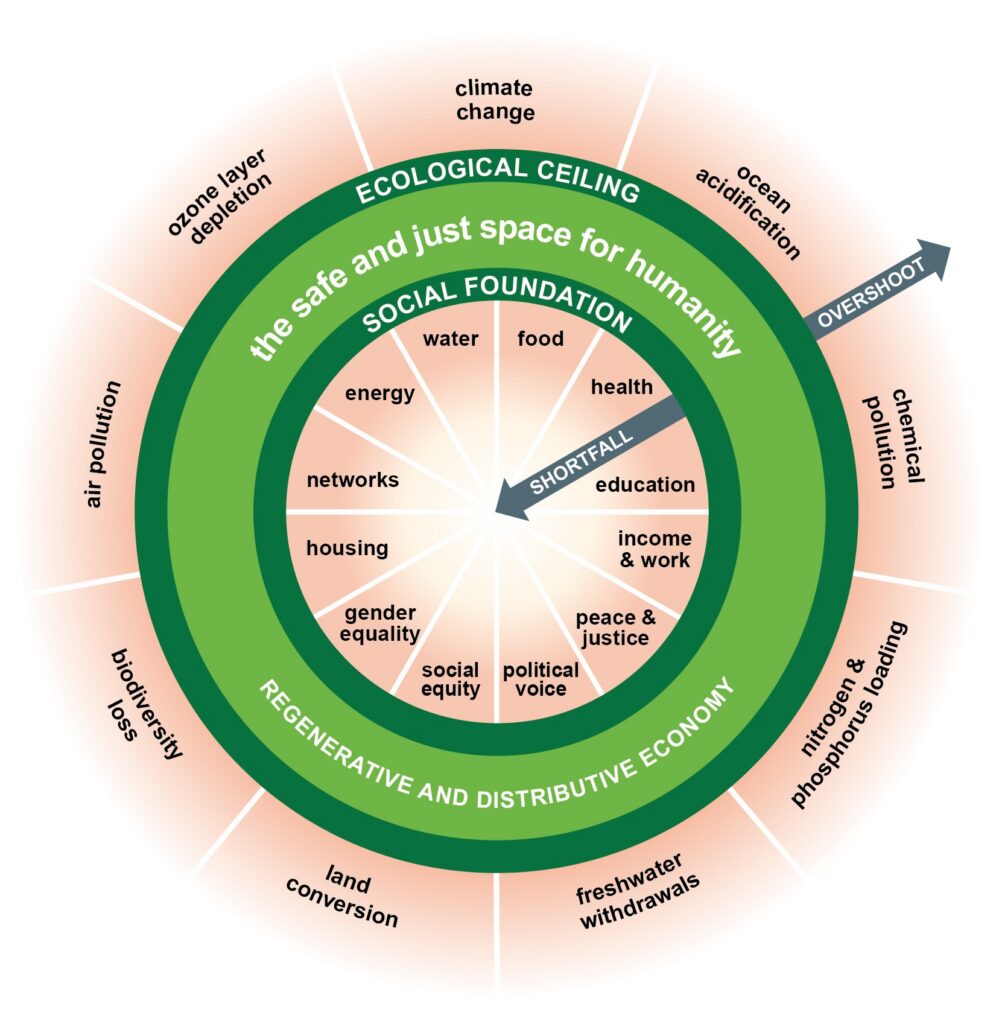
Take Kate Raworth’s “Doughnut Economics.” She’s mapped out this sweet spot where we stay within what the Earth can handle while still meeting everyone’s basic needs. Schumacher saw this coming decades ago with “Small is Beautiful,” questioning our automatic assumption that bigger is always better.
Likewise, Meadows’ “Limits to Growth” confronted us with an uncomfortable truth: infinite growth is impossible on a finite planet. What if abundance came from our ability to give rather than accumulate? Sara Horowitz’s work on mutualism shows how people can organize to support each other rather than compete. Marshall Sahlins’ “Stone Age Economics” tells us that abundance and sharing (not scarcity and competition) were the original economic principles.
All of these ideas point toward something deeper about how we relate to each other economically. Along with many others, these voices represent a kind of counter-culture in economics—thinkers operating at the margins who recognize the economy as part of a living, interconnected system, while mainstream discourse continues down familiar paths of scale and competition.
Economy and society aren’t separate spheres operating independently, but rather expressions of the same fundamental human desire to flourish together.
As I explored these emerging frameworks, I found myself searching for older wisdom that might connect them—something that could help us understand the economy not as a machine, but as a living web of relationships. That search led me to the 18th-century Neapolitan School of Civil Economy, thinkers who grasped something we’re now rediscovering: economy and society aren’t separate spheres operating independently, but rather expressions of the same fundamental human desire to flourish together.
In the Kingdom of Naples, which included much of today’s southern Italy, peasants lived in deep poverty with little chance of social mobility, while nobles and the Church controlled most of the land. Farming methods were backward, with low productivity and frequent famines. The people weren’t facing the disruption of generative AI or the cusp of climate change, yet they knew what it meant to live in an economy that worked for the few while failing the many. It was against this backdrop of systemic dysfunction that a local priest suggested a connection between economics and ethics. Antonio Genovesi, who had long sought to ground metaphysics in human experience rather than abstract theory, proposed that prosperity is both material and moral: an economy without justice, fairness, and solidarity leads to social collapse.
Genovesi was the founding father of what he called “Civil Economy,” developing a series of lessons built on the premise that economics must nurture social solidarity, not just individual enrichment. For him, true wealth wasn’t found in private accumulation but in the well-being of people, the spread of culture, and moral education. His approach wove together applied ethics with economic thinking, sustained by the pillars of trust, reciprocity, and public happiness. But this wasn’t the shallow reciprocity of contracts and transactions. Genovesi envisioned genuine mutual aid that recognized our fundamental interconnectedness. He saw broad-based education and social welfare as the real drivers of development. At the heart of his thinking was the principle that everything is connected in the civil body: tutto è connesso nel corpo civile.
Over 200 years later, we find that happiness didn’t need to be “added” to economics—it was there from the beginning, simply pushed to the margins. And that is where we should look for ways of rebuilding it: the power of the edges. Happiness, reciprocity, and mutualism may not find favor with predominant North Atlantic economic thought, but these principles have endured in many traditional and indigenous communities worldwide. That is why part of my search for economic entanglement brought me to explore and learn from a wider and more diverse repository of governance ecologies, in which lesser-known communities have sustained local economic systems rooted in collective well-being, ecological stewardship, and intergenerational responsibility—principles that echo what Genovesi understood centuries ago about the inseparable relationship between human prosperity and economic health.
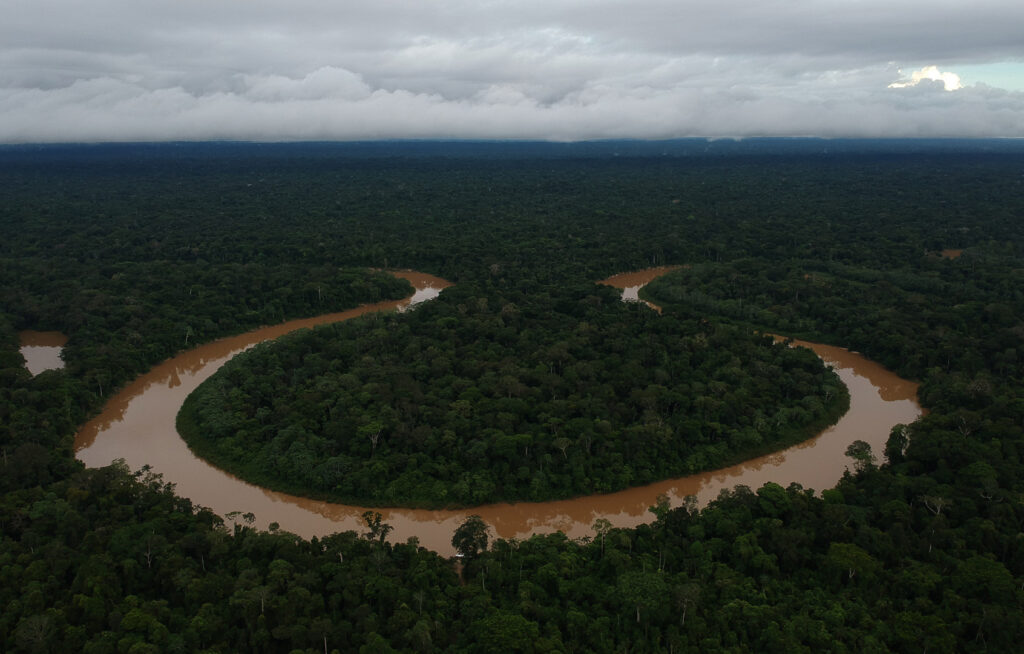
In the Xingu region of the Amazon basin, for example, hundreds of indigenous people have built a networked economy rooted in ecological healing, where native seed collection and commercialization generate livelihoods while restoring degraded landscapes—all coordinated through collective democratic decision-making.
In New Zealand, the Waikato-Tainui community upholds that “the river is us,” engaging in hydrological restoration that prioritizes human–river relations through long-term stewardship for future generations. In Nepal’s Himalayan region, community forestry has transformed millions of hectares of degraded land into productive forests, creating extensive employment while generating income through sustainable forest products—all governed by local democratic institutions that balance community needs with global climate benefits. Likewise, in Tanzania’s southeastern region, village communities have woven together forest stewardship and economic prosperity, where elected committees govern sustainable timber harvesting from miombo woodlands. Their activities generate substantial revenue while democratically investing half of all earnings in community development projects that strengthen the very social fabric supporting their forests. In each of these communities, economic activity becomes a practice of care: for the land, for each other, for future generations.
When economic logic reconnects with ecological reality, when individual prosperity links to collective wellbeing—the old trade-offs dissolve.
Entanglement isn’t just a property of particles, but a fundamental principle of existence. These living examples show us what happens when we design our economic systems to honor rather than sever these connections. They show us that when systems are properly entangled—when economic logic reconnects with ecological reality, when individual prosperity links to collective wellbeing—the old trade-offs dissolve. We no longer have to choose between efficiency and equity, growth and sustainability, because entangled systems generate abundance through relationship rather than extraction.
Once again: Galeano’s upside-down world doesn’t need to be flipped; it needs to be rewoven. And in the patient work of these communities—tending forests, healing rivers, building democratic institutions—we glimpse the careful, daily practice of reweaving our world back together. Thread by thread, seed by seed, they are showing us the way home to an economy that serves all life. In their hands, the civil economy isn’t just an idea from the past—it’s a blueprint for the future we so desperately need.
To provide the best experience, we use technologies like cookies to store and/or access device information. Consenting to these technologies will allow us to process data such as browsing behavior or unique IDs on this site. Not consenting or withdrawing consent may adversely affect certain features and functions.
Functional
Always active
The technical storage or access is strictly necessary for the legitimate purpose of enabling the use of a specific service explicitly requested by the subscriber or user, or for the sole purpose of carrying out the transmission of a communication over an electronic communications network.
Preferences
The technical storage or access is necessary for the legitimate purpose of storing preferences that are not requested by the subscriber or user.
Statistics
The technical storage or access that is used exclusively for statistical purposes.The technical storage or access that is used exclusively for anonymous statistical purposes. Without a subpoena, voluntary compliance on the part of your Internet Service Provider, or additional records from a third party, information stored or retrieved for this purpose alone cannot usually be used to identify you.
Marketing
The technical storage or access is required to create user profiles to send advertising, or to track the user on a website or across several websites for similar marketing purposes.

.jpg)